
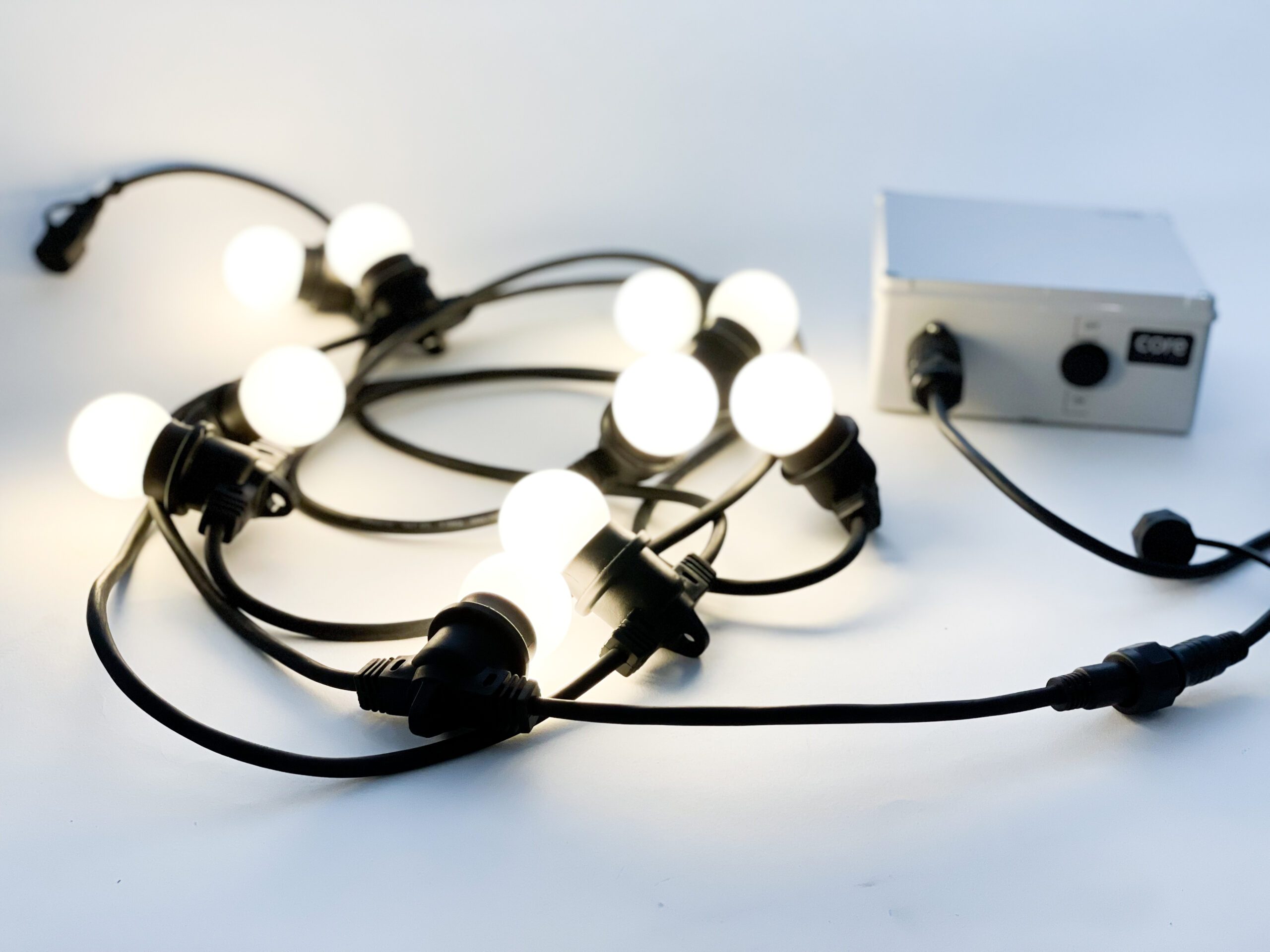
The venue is perfect. The brief is strong. The client has signed off. Then you find out the nearest power socket is 40 metres away, the venue has a no-generator clause, and the lighting plan relies on festoon strings across an outdoor space that cost a significant sum to hire.
It is a scenario event professionals encounter more often than it should happen. Battery festoon lights have made it a solvable problem rather than a compromise – but only if the specification is right.
This guide covers what to look for when specifying battery festoon lights for professional outdoor events, the mistakes that catch experienced planners out, and the questions worth asking any supplier before the season runs away with you.
Why Battery Festoon Lights Have Become the Professional Default
Festoon lighting has always created a particular atmosphere – warm, generous, and immediately readable as occasion rather than function. The problem has always been infrastructure. Outdoor venues with limited power access, listed buildings with restrictions on electrical installations, and rooftop or terrace spaces that simply cannot accommodate a generator have historically forced event planners to choose between the look they want and the constraints they face.
Battery-powered festoon lights removed that choice. A professional-grade battery festoon string can run for a full event day on a single charge with no mains connection required. The same IP65 rating that makes them suitable for outdoor use in the UK’s unpredictable summer weather means they perform reliably in the conditions outdoor events actually encounter.
The operational advantage is equally significant. A small crew can string and position battery festoon lights in a fraction of the time of a wired equivalent, with no cable management to plan and no electrician required on site. For back-to-back event schedules where load-in windows are measured in hours, that is a meaningful difference.
How the Battery Power System Works
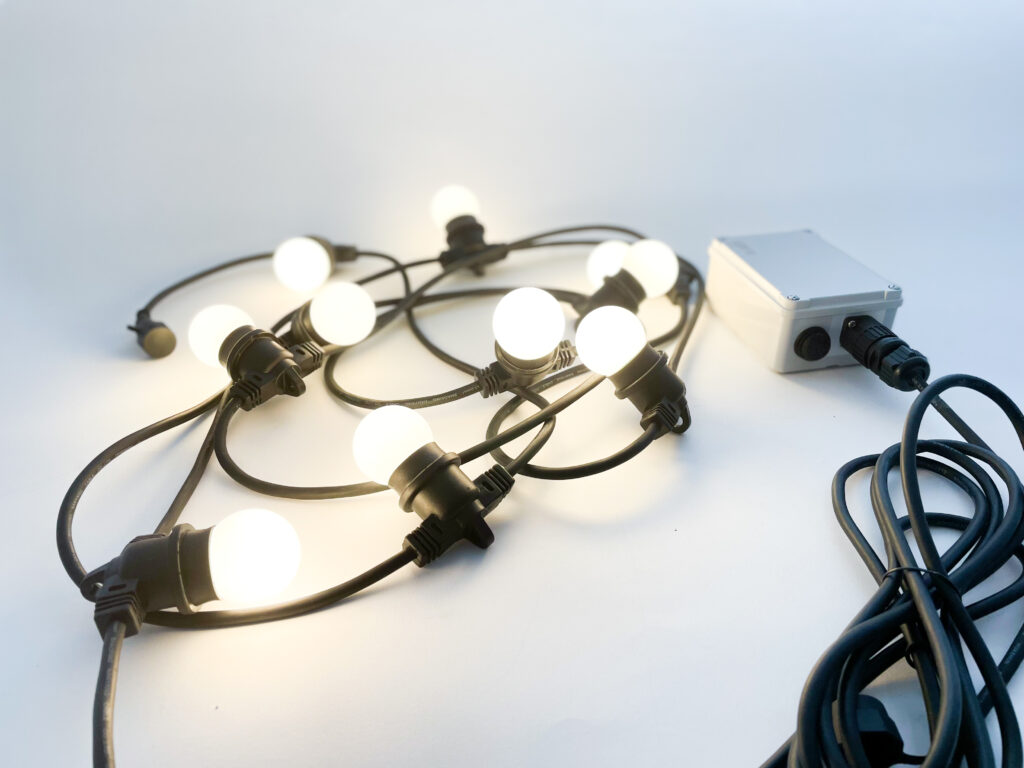
Understanding how professional battery festoon lights are powered makes it easier to specify the right configuration for a given event. The CORE festoon range runs from the EnergyPoint – a dedicated lithium ion battery pack designed specifically for professional event use.
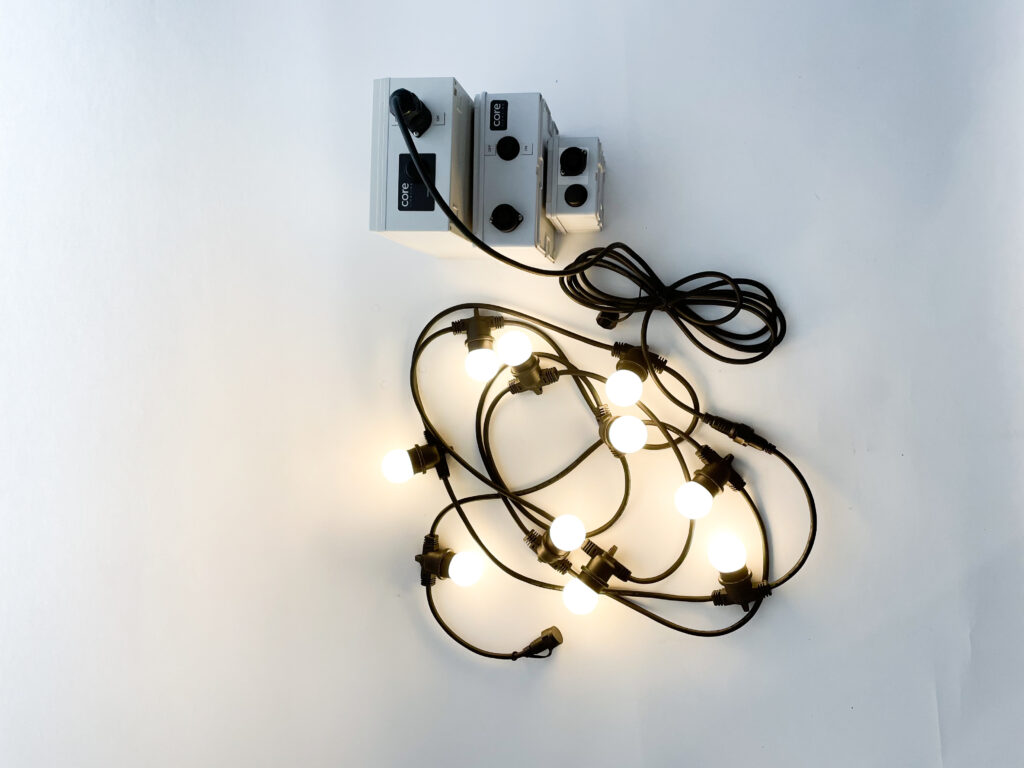
A single EnergyPoint can power multiple festoon strings simultaneously, because the strings are designed to link directly to each other. One battery pack can run up to 50 metres of festoon lighting – that is 10 strings – for over 11 hours on a single charge. For smaller installations, four strings from a single EnergyPoint will run for up to 28 hours, which covers even the most demanding multi-day event without a recharge.
The EnergyPoint is available in five capacity options: 8Ah, 16Ah, 24Ah, 47Ah, and 96Ah. The right choice depends on the number of strings required and the runtime needed between charges. For a compact setup requiring three or four strings across a marquee, the smaller capacity packs provide a lightweight, highly portable solution. For large outdoor installations covering significant distances, the higher capacity options extend runtime and reduce the number of battery changes required across a multi-day event.
The battery pack itself weighs between 0.5kg and 3kg depending on capacity, and comes with a carry case for protection and transport. The loop handle makes it straightforward to move between locations – relevant for venue setups where the power source needs to be positioned and repositioned during the event or across successive days.
The entire installation – festoon strings and EnergyPoint – is fully weatherproof when connected, maintaining the IP65 protection that professional outdoor use requires. The festoon bulbs are polycarbonate rather than glass, which means they can be installed and taken down for events repeatedly without the risk of breakage that glass alternatives carry.
Solar compatibility
For events where recharging from the mains between sessions is impractical, the CORE festoon range is fully compatible with CORE’s solar-powered lighting units. This is particularly relevant for multi-day outdoor events, festivals, and installations in remote locations where generator access is restricted and mains power is unavailable. Solar recharging during the day keeps the installation running through successive evenings without any wired power infrastructure.
The Five Specification Mistakes That Catch Event Planners Out
Battery festoon lights have come a long way. The range of products available has expanded significantly. But we see the same specification errors made at events every summer, often by experienced planners working from assumptions formed when the product category was less developed.
1. Assuming all battery festoon lights are built for professional use
They are not. Consumer festoon lights are designed for occasional garden use. The bulb construction, the cable gauge, the IP rating, and the recharge cycle specification are all different from a product built for repeat professional deployment across a season of events.
The difference is not always obvious from a product listing. A consumer string and a professional string can appear similar on paper and look identical in a photograph. The performance gap becomes apparent when a string fails mid-event, when colour temperature drifts across a run, or when a battery that was supposed to last twelve hours runs out at nine.
2. Buying on price per metre
Price per metre is one of the least useful metrics for evaluating professional festoon lighting. It tells you nothing about bulb quality, cable durability, colour rendering consistency, IP rating, or how the product behaves after its fiftieth deployment of the season.
A professional-grade battery festoon string costs more per metre than a consumer equivalent. That cost reflects the specification decisions that determine whether it performs reliably in professional conditions – not marketing.
3. Ignoring the IP rating for outdoor use
IP65 is the minimum rating for any festoon light used outdoors. IP65 means the fixture is fully dust-tight and protected against water jets from any direction – which covers rain, dew, and the cleaning that professional equipment requires between events.
Some products carry lower ratings described in terms that imply outdoor suitability without meeting the IP65 standard. If the IP rating is not clearly stated in the product specification, treat it as unrated for outdoor use.
4. Underestimating lumen output for large spans
A 10-metre festoon string above a bar creates a different light quality to the same string spanning 30 metres across an open courtyard. Lumen output, mounting height, and the reflective properties of the surrounding environment all affect how much light actually reaches the space below.
For large outdoor spans, the festoon lighting needs to work harder to create the atmosphere the brief calls for. Specifying on total string length without accounting for the span and the environment is a common route to an underwhelming result.
5. Forgetting about charge cycles for back-to-back events
Runtime is one half of the battery equation. Recharge time is the other. For event companies running a busy summer calendar, the gap between a Saturday night finish and a Sunday afternoon setup can be shorter than a standard product’s charge cycle.
With the EnergyPoint system, the modular battery configuration means you can run additional packs alongside each other for extended coverage, or swap packs between events rather than waiting for a single unit to recharge. That flexibility is worth building into the specification from the start, particularly for companies handling back-to-back bookings through August and September.
The Questions to Ask Before You Specify
Any professional supplier should be able to answer the following questions clearly. If they cannot, the product is probably not built to professional standards.
- What is the runtime at full brightness, and for what configuration? For CORE battery festoon lights: up to 11 hours for 50 metres (10 strings) from a single EnergyPoint, or up to 28 hours for four strings. These are the figures that matter for event planning, not a headline maximum at reduced output.
- How many strings can one battery pack run simultaneously? The EnergyPoint is designed to run multiple linked strings from a single unit. Confirm this for any product you are specifying – some battery festoon systems require a separate power source per string.
- What battery capacities are available? The EnergyPoint range runs from 8Ah to 96Ah. The right capacity depends on the installation size and the runtime required between charges.
- What is the IP rating? IP65 minimum for outdoor use, with documentation to back it up.
- What is the bulb construction? Polycarbonate is the professional standard for event use – it survives repeated installation and removal without the breakage risk that glass carries.
- What is the colour temperature, and is it consistent across the full string? Warm white is typically 2700K-3000K. Consistency matters – a string that drifts between bulbs looks unprofessional regardless of individual output.
- Is solar recharging available? For multi-day events or remote locations without mains access, solar compatibility significantly extends the operational range of a battery festoon installation.
Two Briefs That Look the Same but Are Not
Battery festoon lights appear in two event contexts so regularly that it is worth treating them separately, because the specification demands are different even when the product is the same.
Outdoor weddings
Atmosphere is the primary brief. The light needs to be warm, consistent, and flattering – creating a sense of occasion without drawing attention to itself. Runtime requirements are demanding: a wedding typically runs from late afternoon through to midnight or beyond, which means 10 or more hours of continuous operation.
The venue is often a listed building, a walled garden, a marquee field, or another setting where power access is limited and the aesthetic integrity of the space matters. Reliability is non-negotiable. There are no retakes at a wedding, and a lighting failure at 9pm is not a recoverable situation.
For a typical outdoor wedding installation, a single EnergyPoint at an appropriate capacity will run the full event from setup to finish with no mid-event battery changes required. The polycarbonate bulbs mean the strings can be put up and taken down without damage, which matters for venues where the lighting is installed the morning of the event.
Corporate summer events
Brand alignment becomes more important here. The lighting may need to complement a colour scheme or work alongside other branded elements in a way that a warm-white-only string cannot achieve. A product with colour temperature options gives more flexibility.
Load-in windows for corporate events are typically tight. A two-hour setup before guest arrival is common, which means the lighting needs to be fast to install and require minimal adjustment once positioned. The EnergyPoint’s loop handle and carry case make it straightforward to position and reposition during setup without additional equipment.
For event companies running a full summer calendar, the modular battery configuration is worth factoring in. Running multiple EnergyPoint packs in parallel, or keeping a charged spare on hand, removes the recharge constraint from a back-to-back weekend schedule entirely.
What the IP65 Rating Actually Means for UK Outdoor Events
IP ratings are worth understanding clearly, because they are frequently misapplied in product marketing.
IP65 is a two-digit rating. The first digit (6) indicates total protection against dust ingress. The second digit (5) indicates protection against water jets projected from any direction. This is the standard that makes a festoon light genuinely suitable for outdoor use in UK conditions – including rain during setup, dew overnight, and wet ground conditions.
IP44, which appears on some outdoor-marketed products, indicates splash protection only. It does not cover rain from directly above, water during setup, or the sustained exposure an outdoor event involves.
With CORE battery festoon lights, IP65 protection applies to the full installation when the strings are connected to the EnergyPoint – the battery pack and the festoon connection point are both rated to the same standard. There is no weak link in the system when it is assembled correctly.
For professional outdoor event use, IP65 is the minimum. Anything lower is a risk to equipment reliability, crew safety, and professional liability.
Choosing the Right Specification for the Rest of the Season
The summer outdoor event season runs into September and beyond. Corporate parties, weddings, and outdoor dinners continue on the calendar long after the peak summer months.
If your current festoon specification was assembled quickly at the start of the season, or if you have been working with consumer-grade product that has been performing adequately but not reliably, now is a reasonable moment to review it.
The CORE battery festoon range – running from the EnergyPoint in configurations from 8Ah to 96Ah, compatible with solar recharging, IP65 rated throughout, and built for repeat professional deployment – is designed for exactly the conditions outdoor event professionals work in.
ABOUT CORE LIGHTING
CORE Lighting designs, manufactures, and supports professional event and exhibition lighting products in the UK, based in Gloucestershire. The CORE range includes battery festoon lights, battery powered exhibition lights, and wireless display lighting built for event and exhibition professionals.