
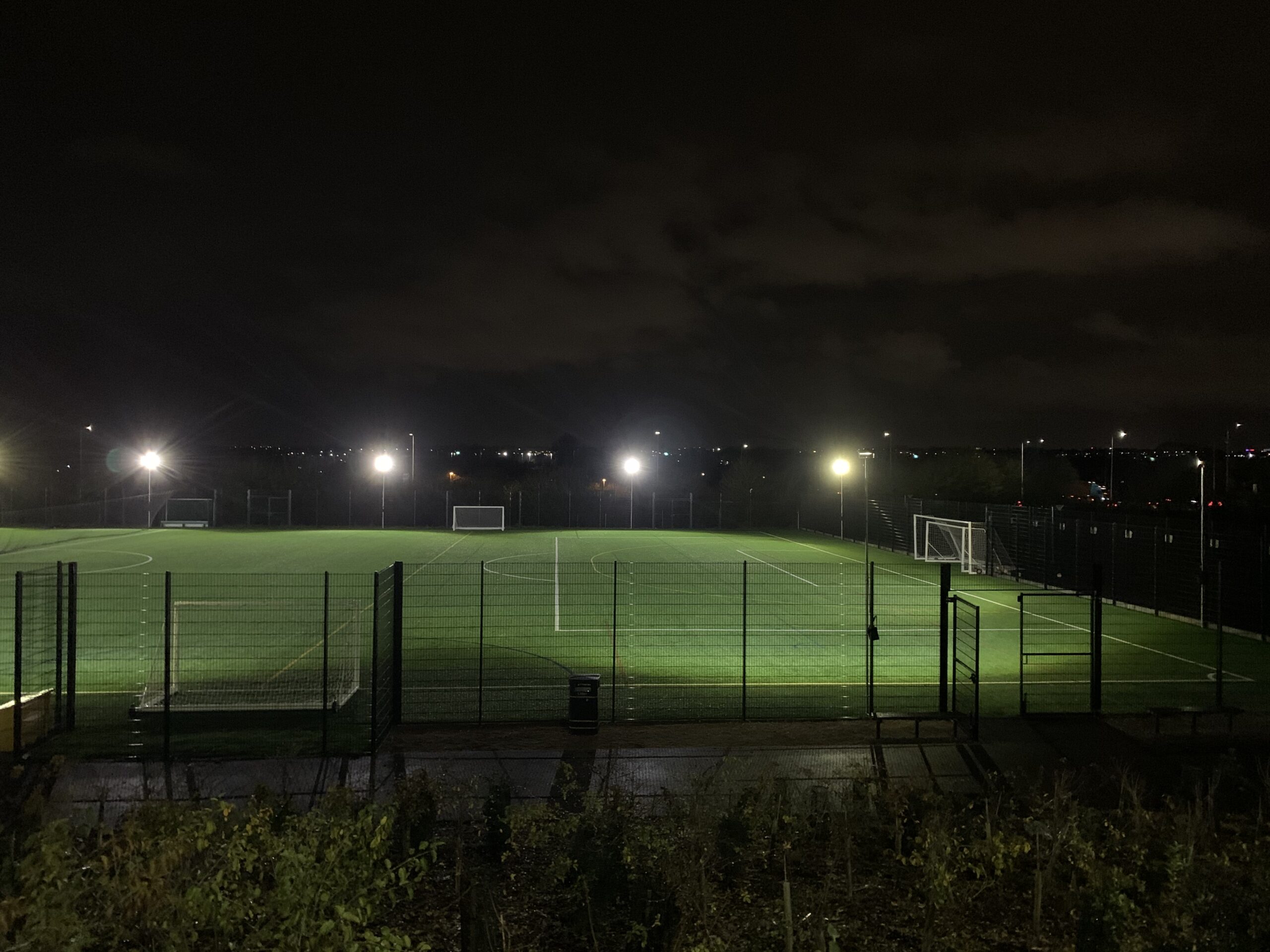
The clocks go back at 2am on Sunday 25 October. Overnight, an hour of usable evening light disappears, and it keeps shrinking until the shortest day in December, when sunset falls before four o’clock across most of the UK.
For a lot of outdoor operations, that isn’t a seasonal inconvenience. It changes their operating hours. The Tuesday training session, the evening tennis booking, the schooling slot after work, the last hour of a shift on site. Some of those have permanent lighting. Many don’t, and never will, because it’s too expensive to install, isn’t permitted, or isn’t needed all year round.
This guide covers where portable battery floodlights make sense, where they don’t, and how to choose between the units in the CORE FLOOD range.
Why battery rather than a generator or mains
Temporary floodlighting has traditionally meant one of two things: a generator, or a cable run from the nearest socket. Both have the same problems in the places that need lighting most.
Cables across a pitch, a yard or a site are trip hazards and vehicle hazards. Around horses, they’re something worse. Generators need fuel, refuelling and someone to start them, they can spill, and they’re loud. That matters on a training ground, next to a stable block, near neighbours, or anywhere people need to hear each other.
A battery floodlight removes all of that. It needs no external power, makes no noise and has no fuel to spill. It can be set up in minutes and moved when the session or the work moves. CORE’s LED floodlights also use between a seventh and a tenth of the electricity of traditional halogen area lighting, so recharging costs very little.
Because the units are temporary and portable, they don’t need planning permission in most places. If you plan to leave lighting in position permanently, check with your local authority first.
Portable sports floodlights for clubs, courts and training grounds
To be clear about what portable floodlighting is for: it isn’t a replacement for the permanent, league-standard floodlighting that governing bodies specify for competitive fixtures. If you need that, you need columns.
What portable sports floodlights do well is almost everything else. CORE FLOOD lights are used for football, rugby, tennis, padel, hockey, netball, cricket and outdoor bootcamps. They let you create a training area wherever you need one: a corner of the main pitch, an unlit court, a MUGA, or a section of a municipal park. They’re designed for all surfaces, and they can save a club the cost of hiring a floodlit venue for winter training.
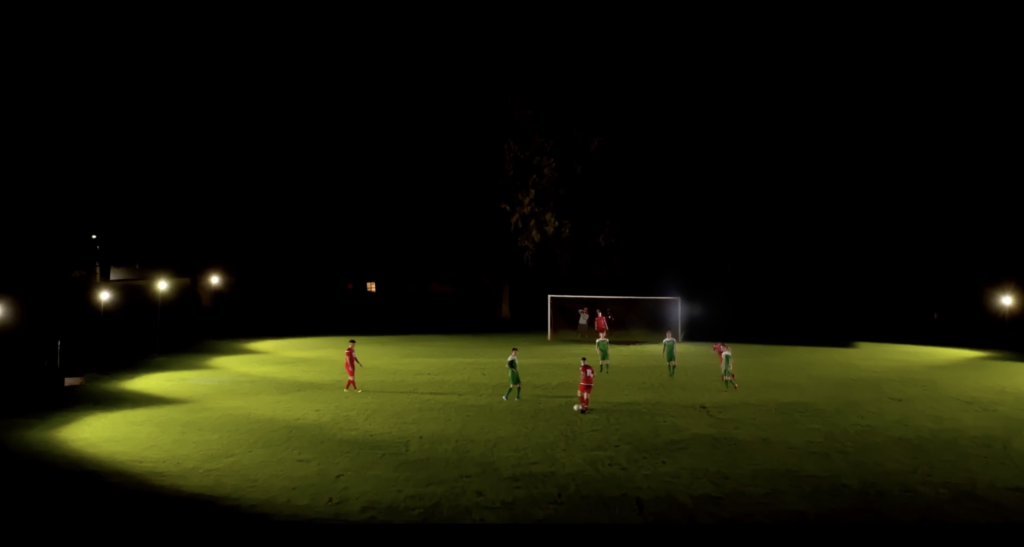
Portable football floodlights for training
Many clubs have one floodlit pitch and a lot of teams wanting to use it. Running training on a separate, portably lit area takes the pressure off the main surface and preserves the grass for match days. Junior sessions, small-sided games and goalkeeper training can all move to wherever there’s space, and the same approach works for rugby and hockey.
On a soft winter pitch, stability matters. The battery sits low on the stand to keep the weight down, and a ground screw secures the tripod firmly in soft ground and high winds.
Tennis court lighting and padel
Tennis is one of the biggest uses for CORE FLOOD lights. An unlit court is out of action for most of the evening from late October to March, and permanent court lighting means columns, cabling and, in many cases, a planning application. Portable floodlights let clubs, schools and coaches keep courts in use through the winter without any of that.
The lights can stand on their tripods around the court or be attached to the court fencing with CORE’s fencing accessories. Fence set-ups vary, so talk to the team about what yours needs. The same approach works for padel courts, netball courts and multi-use games areas.
Light on the playing surface, not the sky
Most floodlights have little or no beam shaping, so the light spreads out in a wide cone from the LEDs, and much of it ends up in the sky and on areas nobody is playing on. CORE FLOOD lights use low glare, custom focusing optics that concentrate the output onto the pitch or court. That means brighter, more even light where people are playing, less light spill for neighbours, and fewer lights needed to cover the same area. Where several lights are used together, the overlapping beams build up the light level towards the centre of the playing area, which reduces shadows.
Funding is available
Grants and funding are available from various sports bodies towards portable floodlights, and some cover up to 100% of the cost. CORE customers have already used grants to buy these lights. For grassroots football, the Football Foundation runs a dedicated portable floodlights grant. Talk to the team about the options and how the process works.
Arena lighting for equestrian yards
Winter is the hardest season for anyone who rides or keeps horses around a working day. Schooling after work, mucking out, bringing in and turning out, loading lorries in the dark: all of it gets squeezed into hours with no daylight left.
It’s also where the case against cables and generators is strongest. A horse doesn’t care that the cable is taped down, and a generator starting up is exactly the kind of noise you don’t want next to a nervous animal.
For scale: CORE’s own figure is that four FLOOD 20K units light an area of 50m by 30m, which is 1,500 square metres. A standard 20m by 60m dressage arena is 1,200 square metres. Each FLOOD 20K head sits on a 3.5m stand, with a ground screw to hold it steady in an open arena in November.
Temporary site lighting for construction, utilities and industrial work
On a new site there is often no mains supply where the work is happening, and the work doesn’t stop at sunset. Night shifts, compounds, road and rail maintenance, utilities work and public access routes all need light that can be put in place quickly and moved as the job progresses.
The CORE FLOOD PRO 24K was designed for exactly this. It runs for 7 hours at full brightness and up to 22 hours on low, and it’s rated IP67 for the harshest weather. The battery and charger travel in a shoulder bag, and the head mounts on a 3.5m extendable tripod. For larger work areas, CORE’s figure is that four FLOOD PRO units light 60m by 45m, or 2,700 square metres.
Car parks, pathways and facilities
Facilities managers and groundskeeping teams tend to need light for shorter, less predictable jobs: a failed permanent fitting, a busy winter fixture, a pathway that needs to be safe for one evening, maintenance work after hours. The CORE FLOOD 20K and FLOOD PRO 24K both set up quickly for this. For jobs where everything needs to arrive in one piece, the CORE FLOODBOX packs the light, battery and pole into a single wheeled case.
Which CORE FLOOD suits your site
CORE FLOOD 20K
The all-rounder for pitches, courts, arenas and large areas. It produces 20,000 lumens through a focused 90 degree lens, from a 3kg head on a lightweight 3.5m stand with a ground screw. It’s IP65 rated and comes in two battery versions, 26Ah and 52Ah. Where a mains supply is available, you can choose a mains power box instead of a battery box. It looks the same and connects to the light head in the same way, but has a 110V or 230V power supply inside instead of a battery, so the light runs for as long as it’s plugged in. Each light head runs from either one battery box or one mains power box. Recent upgrades include quick-release metal connectors and an improved, soft-closing tripod that is fast to put up and safe to take down. View the CORE FLOOD 20K
CORE FLOOD PRO 24K
The choice for long sessions, long shifts and bad weather. It delivers 24,000 lumens from a 1,040Wh battery, with 7 hours at full brightness, and it’s IP67 rated. Battery and charger travel together in a shoulder bag, or in an optional ABS carry case, and the head mounts on a 3.5m extendable tripod. View the CORE FLOOD PRO 24K
Runtimes at a glance
| Model | Output | Battery | Full | Medium | Low |
| CORE FLOOD 20K (26Ah) | 20,000 lm | 280Wh | 2hrs 10 | 4hrs | 6hrs |
| CORE FLOOD 20K (52Ah) | 20,000 lm | 560Wh | 4hrs 15 | 8hrs | 13hrs |
| CORE FLOOD PRO 24K | 24,000 lm | 1,040Wh | 7hrs | 14hrs | 22hrs |
Both FLOOD 20K battery versions cover most evening training sessions, and the medium setting roughly doubles the runtime of every model.
What’s in the kit
Each CORE FLOOD comes with the light head, the battery pack in a bag with a carry strap, a charger, a ground screw and a quick start leaflet. A tripod bag, a carry bag for the battery, head and charger, and fencing accessories are available separately.
CORE FLOODBOX
An all-in-one alternative: a wheeled case containing the battery, charger and a 2m pole, with 4 hours at full brightness. It comes with one or two LED heads, giving 20,000 or 40,000 lumens. The two-head version weighs 23kg, which is about the limit of what one person can comfortably carry, so the single head version may suit if it will be moved often. It’s IP65 rated and can run from 240V or 110V mains to extend the runtime. View the CORE FLOODBOX
How bright is 20,000 lumens? A note on “equivalent” figures
When you compare floodlights, you’ll see some manufacturers quote an “equivalent” lumen figure alongside, or instead of, the actual output. It’s worth understanding what that means.
Lumens measure the total amount of light a lamp produces. An “equivalent” figure starts from the assumption that a typical floodlight, with a wide unshaped beam, wastes much of its output on the sky and on areas that aren’t being lit. It then works out how powerful that typical light would need to be to put the same amount of light onto the playing surface as the focused light does.
Calculated that way, the CORE FLOOD 20K is equivalent to 34,000 lumens and the CORE FLOOD PRO 24K is equivalent to 41,000 lumens. We quote the measured outputs of 20,000 and 24,000 lumens first, because that’s what the lights actually produce. The equivalent figures are there so you can compare them fairly with manufacturers who use that method.
Four questions to ask before buying any floodlight
Whichever product you’re looking at, CORE’s or anyone else’s, ask for four numbers:
- The actual lumen output, and whether any figure quoted is an “equivalent”.
- The beam angle it was measured at.
- The runtime at full brightness.
- The IP rating.
Spec sheets can be honest and still not comparable, and these four figures let you compare like with like.
Frequently asked questions
How long do portable floodlights last on a charge?
It depends on the battery and the brightness setting. At full brightness, the CORE FLOOD 20K runs for 2 hours 10 minutes on the 26Ah battery and 4 hours 15 minutes on the 52Ah battery, extending to 6 and 13 hours on low. The CORE FLOOD PRO 24K runs for 7 hours at full brightness and up to 22 hours on low.
Can I light a tennis court with portable floodlights?
Yes. Tennis is one of the most common uses for CORE FLOOD lights. They can stand on tripods around the court or attach to the court fencing with CORE’s fencing accessories, and the focused beam keeps the light on the court.
Is there funding available for portable floodlights?
Yes. Various sports bodies offer grants towards portable floodlights, some covering up to 100% of the cost, and CORE customers have used them to buy these lights. For grassroots football, see the Football Foundation’s portable floodlights grant.
Can battery floodlights be used in the rain?
Yes. Every CORE FLOOD product is rated IP65 for rugged outdoor use, and the CORE FLOOD PRO 24K is rated IP67 for the harshest weather.
Do I need planning permission for temporary floodlights?
Portable battery floodlights don’t need planning permission in most places, because they’re temporary. If lighting will stay in one position long term, check with your local authority.
How many floodlights do I need?
As a guide, four CORE FLOOD 20K units light 50m by 30m (about 16,000 sq ft), and four CORE FLOOD PRO 24K units light 60m by 45m (about 29,000 sq ft). The right number depends on the shape of the space and the task, so it’s worth a conversation before you order.
Built in the UK by CORE Lighting
CORE has been manufacturing battery powered floodlights in the UK for 14 years, and the CORE FLOOD has been in production for 8 of them. If you’re working out what your club, court, yard or site needs before the clocks go back, call the team on +44 1452 812597 or use the enquiry form on any product page.